
Career Guide · Creative Industry 2026
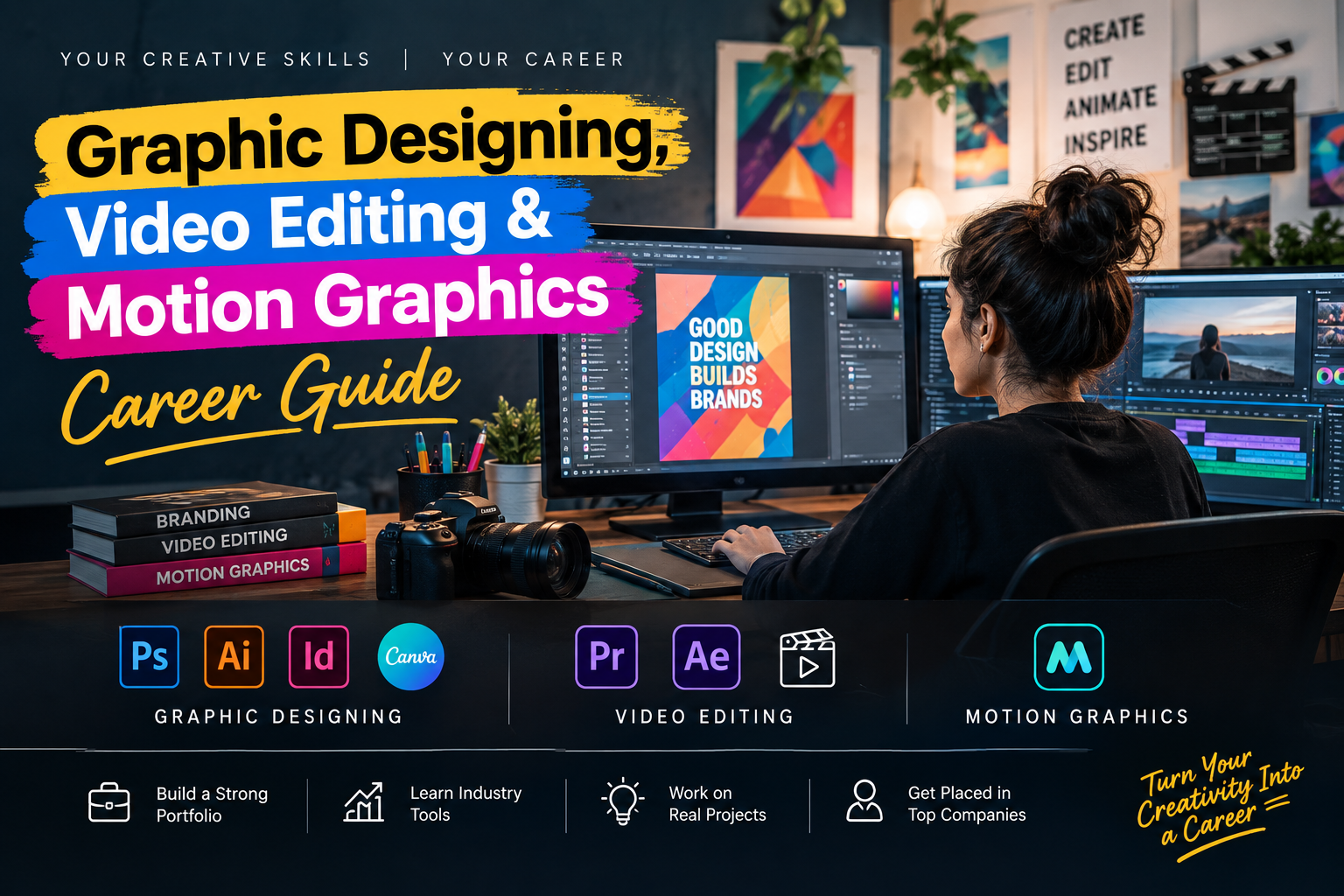
Graphic Designing, Video Editing & Motion Graphics Career Guide
Skills, job roles and future opportunities — from static designs to AI-powered visual storytelling.
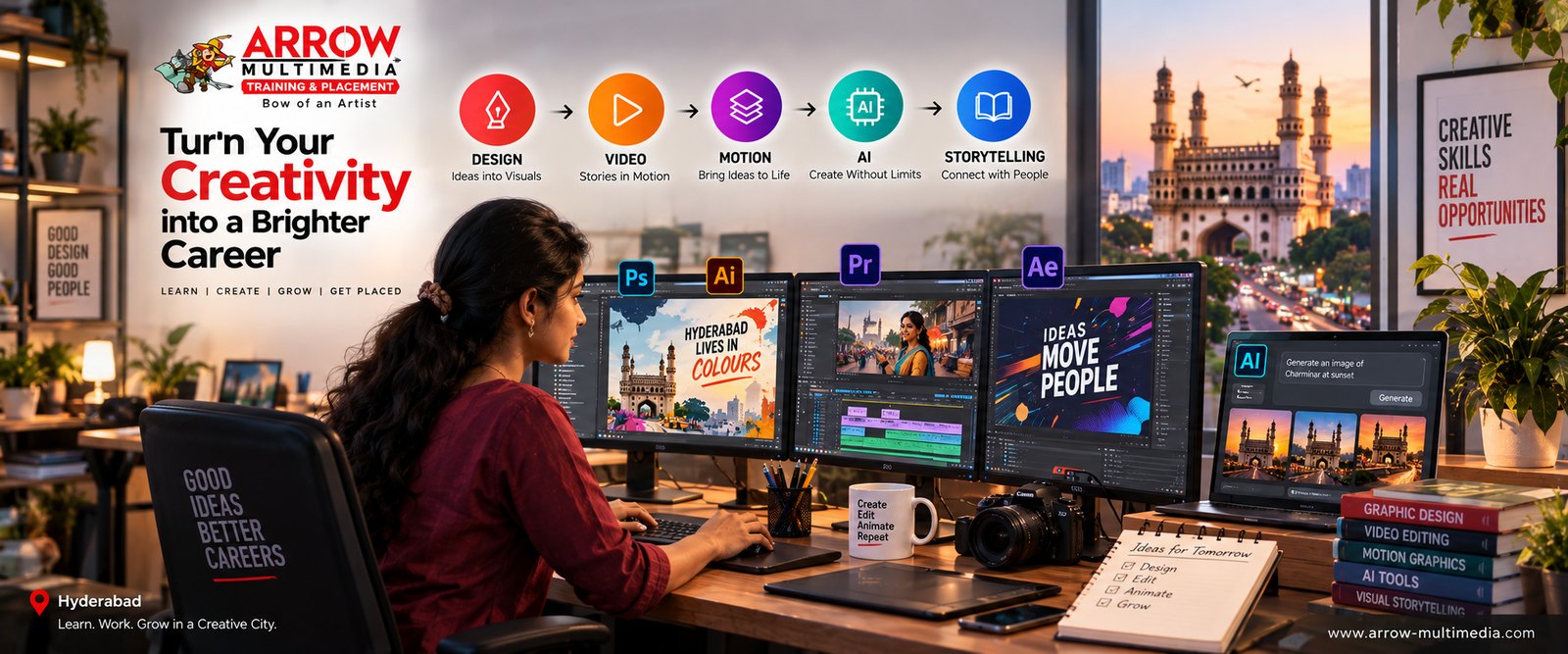
From static designs to AI-powered visual storytelling
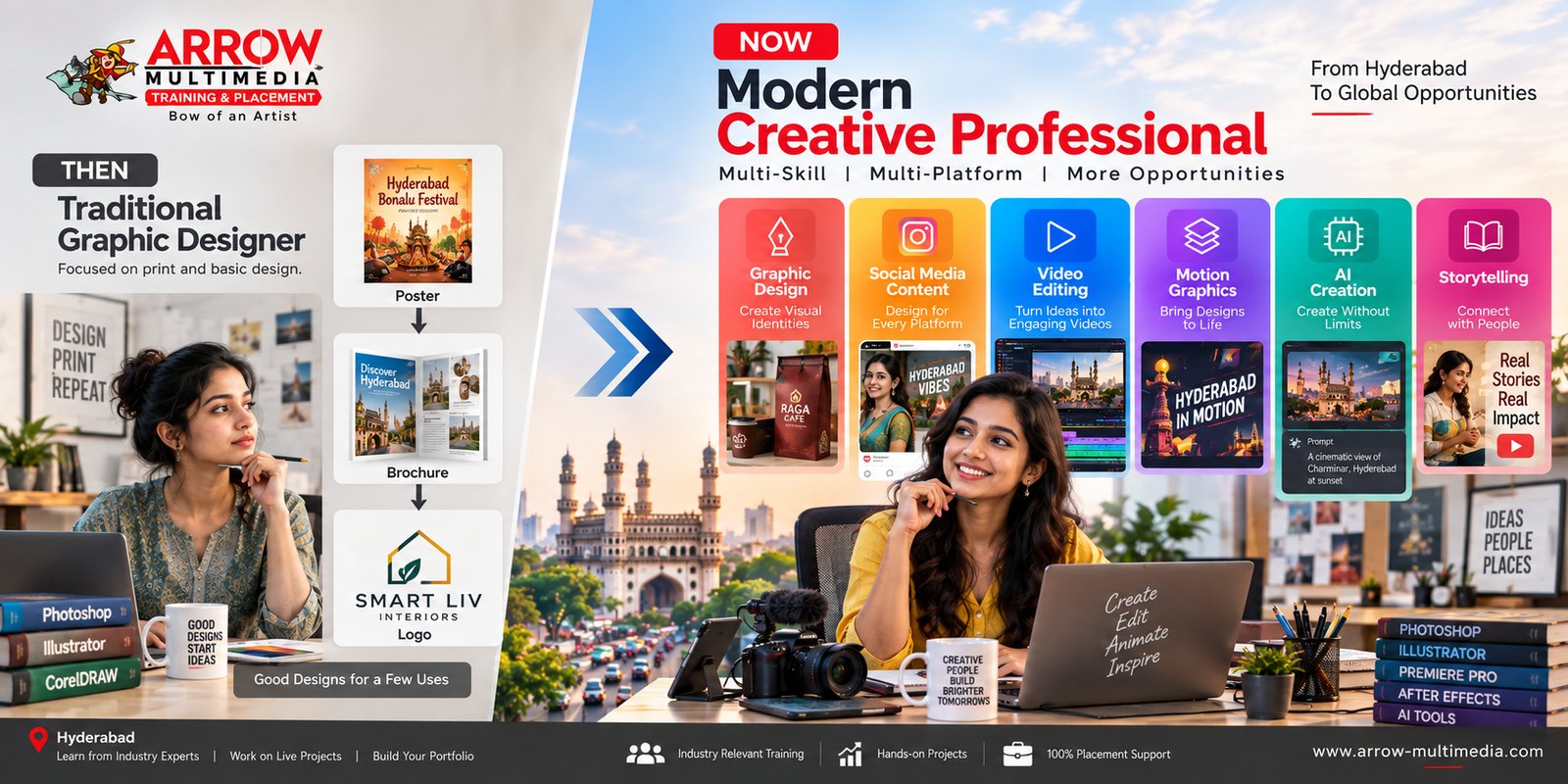
A few years ago, when someone said “Graphic Designer,” the image that probably came to mind was a person creating posters, brochures, logos or advertisements. That definition is changing.
Today, a creative professional may be expected to design a social media campaign in the morning, edit a YouTube video in the afternoon, create motion graphics for a product advertisement, generate visual concepts using AI, prepare a Reel, and deliver multiple versions of the same campaign for different platforms.
The role has moved from making designs to communicating ideas through visual content.
And this change is creating new opportunities across social media companies, YouTube studios, advertising agencies, e-learning companies, television and media, corporate marketing teams, production houses and creator-led businesses.
Is graphic design still a good career?
Yes — but the definition of the career has changed. The strongest opportunities are increasingly available to people who can combine several creative skills rather than depending on only one.
Think about a modern brand launching a new product. The company may need:
One person may not produce everything alone in a large agency. But a versatile creative professional who understands design + editing + motion + content + AI becomes much more valuable to the team.
Recent job listings in India already reflect this combination. A September 2026 Video & Graphic Designer role in Noida asked for social media creatives, short-form video, motion graphics, visual storytelling and hands-on use of AI design and video tools. Another recent listing for a Video Editor & Motion Graphics Designer described generative AI as part of the production workflow rather than an optional technology.
Where can you build a career?
One of the biggest advantages of learning graphic design, video editing and motion graphics together is the sheer number of industries that need visual content.
01 Social media content creation
Every brand needs content. Instagram, YouTube, LinkedIn and other digital platforms have created continuous demand for posts, carousels, Reels, short videos, thumbnails, advertisements, motion graphics and campaign creatives.
A social media designer is no longer designing one poster. A single campaign may need 10–20 different creative formats.
Real-world scenario
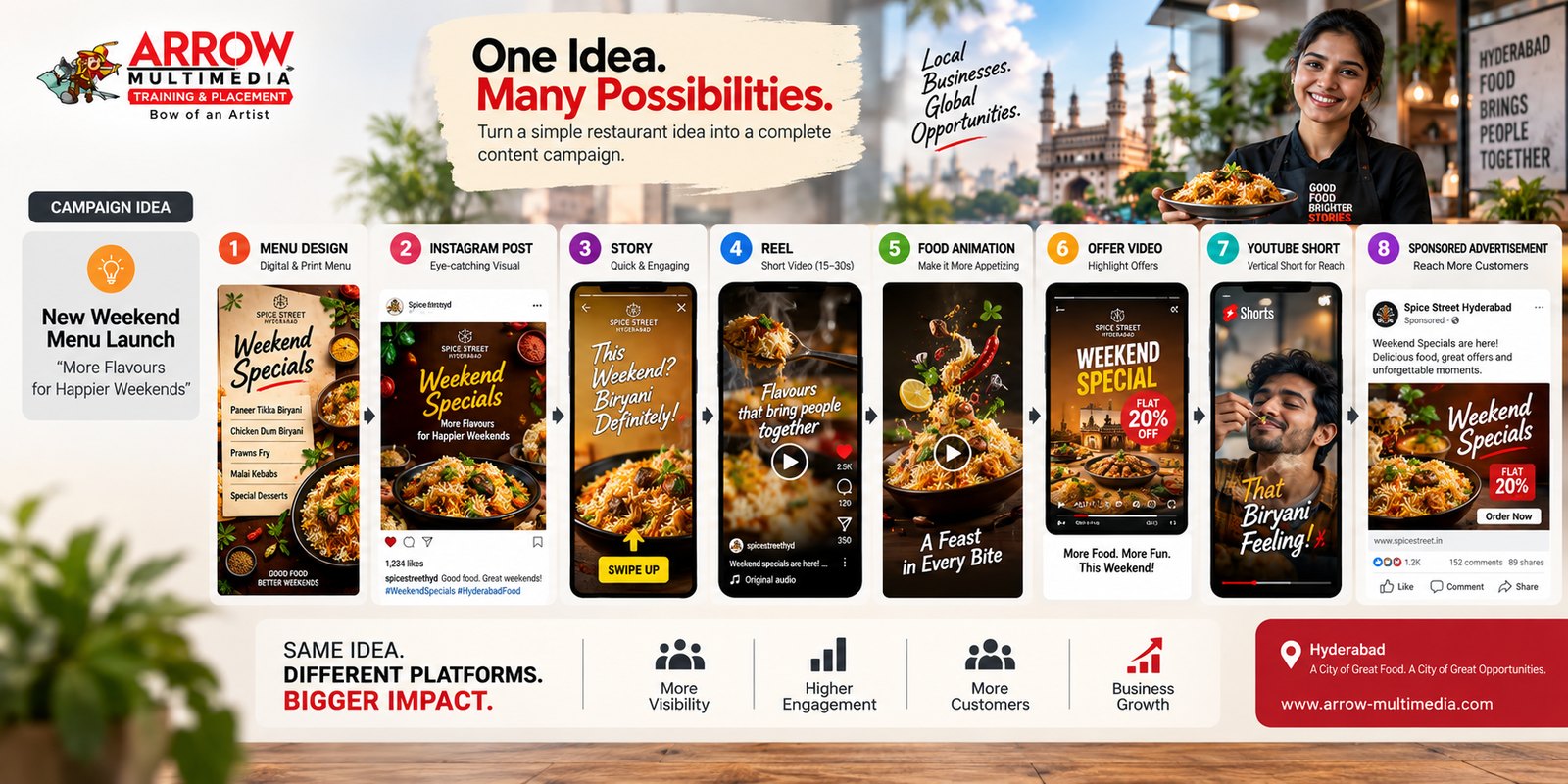
A Hyderabad restaurant is launching a new weekend menu. The creative team might produce:
- Menu design
- Instagram post
- Story
- Reel
- Food animation
- Offer video
- YouTube Short
- Sponsored ad
The same idea becomes multiple pieces of content. That is why understanding both design and video is becoming important.
02 YouTube studios & creator businesses
YouTube has created another major creative ecosystem. A production team may require video editors, thumbnail designers, motion graphics designers, short-form editors, content designers, intro/outro designers, visual effects artists and AI-assisted content creators.
A single long-form video can generate several additional pieces of content:
- 1 YouTube video
- Thumbnail
- 3 Shorts
- 5 Social posts
- 2 Reels
- Promo graphic
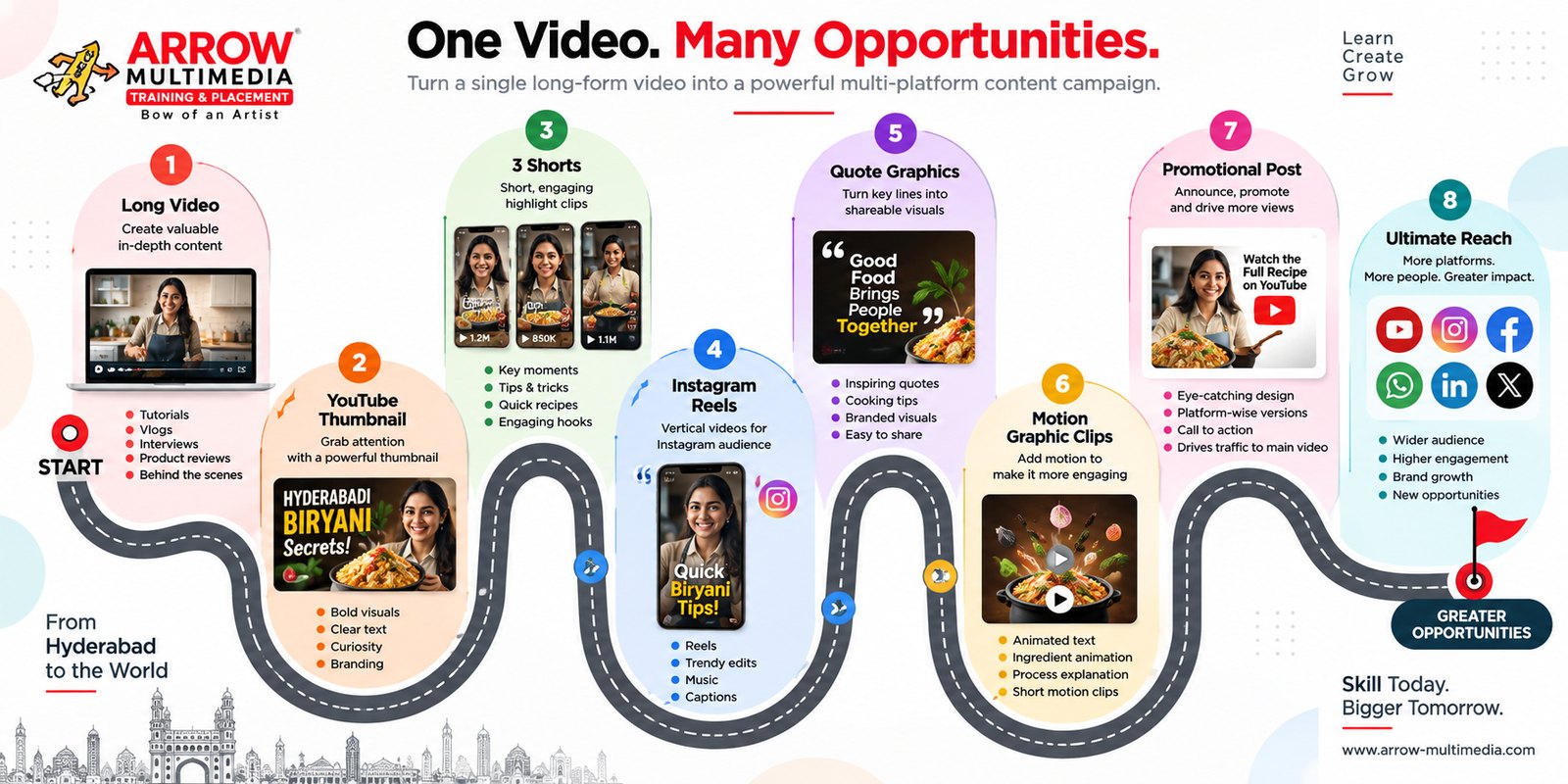
A creative professional who understands this complete content cycle contributes much more than someone who only knows how to cut video.
03 E-learning companies
The growth of online education has created another important career path. E-learning companies need people who can convert information into visually engaging learning experiences.
Real-world scenario
An e-learning company is creating a 20-minute lesson about the human heart. Simply recording a teacher speaking may not be enough. The creative team can transform the lesson into:
- Teacher
- Diagrams
- Animated heart
- Labels
- Transitions
- Motion graphics
- Voice-over
- Final lesson
This is where design, editing and motion graphics work together.
04 Television & media
Television and media production continue to require strong visual communication. Creative roles can include video editing, promo editing, motion graphics, title design, news graphics, infographics, visual effects, broadcast graphics and social media content.
The same media organisation may create content for television, YouTube, Instagram and other digital platforms — so the modern media professional increasingly needs to understand multiple formats and platforms.
05 Advertising agencies
Advertising is one of the most exciting areas for creative professionals. A campaign may begin with one simple idea:
“Make this new smartphone look powerful, premium and desirable.”
That single line becomes a visual identity, a set of key visuals, a film, a series of cutdowns and a full digital campaign. The designer is no longer arranging images and text — the designer is helping communicate a story.
06 Corporate companies, startups & production houses
Creative professionals are also needed inside IT companies, startups, marketing departments, corporate communication teams, production houses, event companies, digital agencies, personal branding teams and creator businesses.
A startup may need everything from a product presentation to a launch video. A corporate company may need internal training videos, presentations, social media content and recruitment campaigns. A production house may need editing, motion graphics and promotional content.
The opportunities are broader than the job title “Graphic Designer” suggests.
The skill stack that creates more opportunities
The most important thing to understand is that these skills are not separate islands. They connect with each other.
Graphic design
Graphic design remains the foundation. Before learning advanced AI or motion tools, a creative professional needs to understand composition, colour, typography, layout and visual hierarchy.
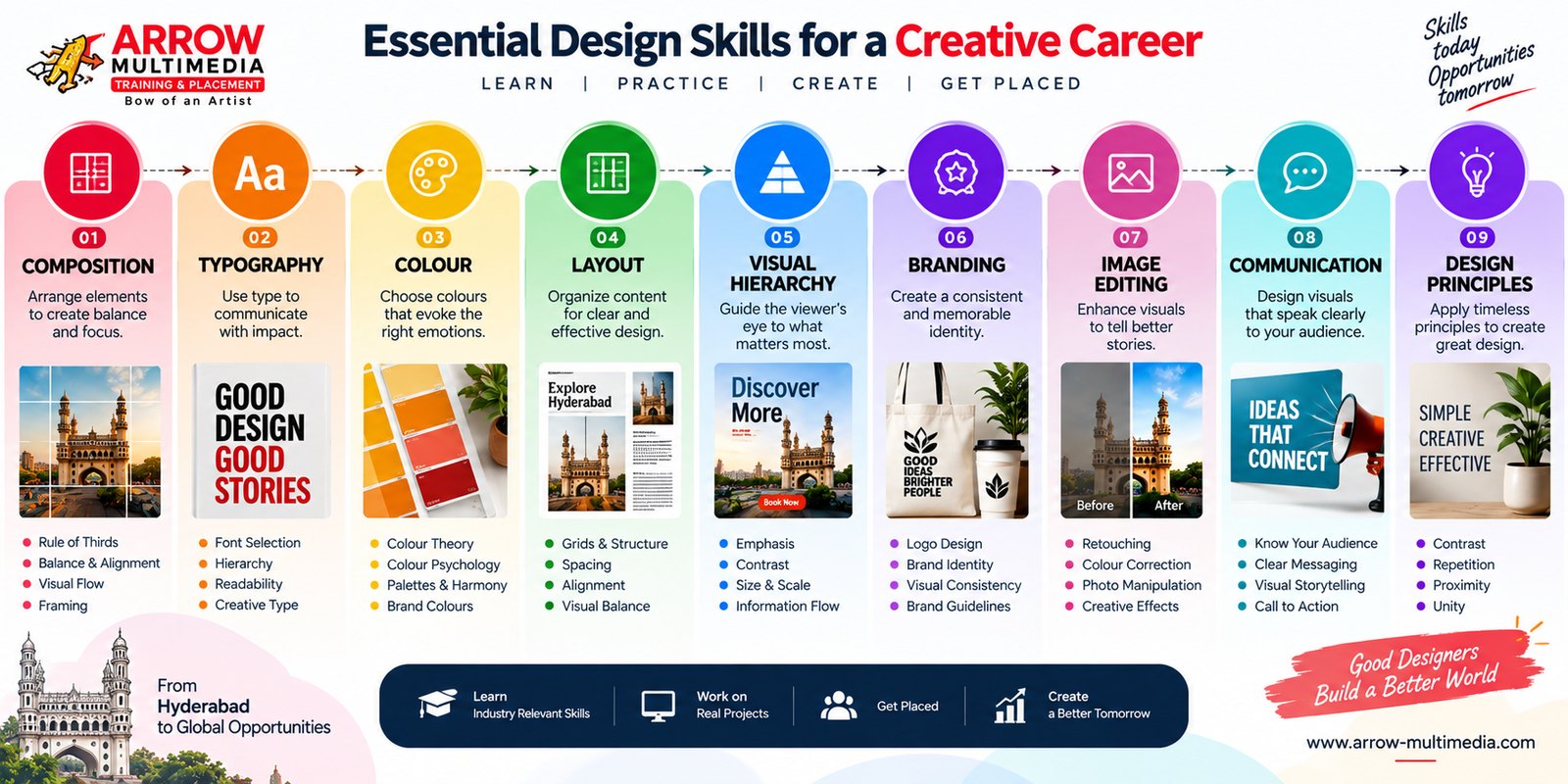
Tools such as Photoshop and Illustrator are still highly relevant. But knowing where to click in Photoshop is not enough. The important question is: why does this design work? A professional designer should be able to explain the choice of colour, typography, spacing, imagery and composition.
Social media content creation
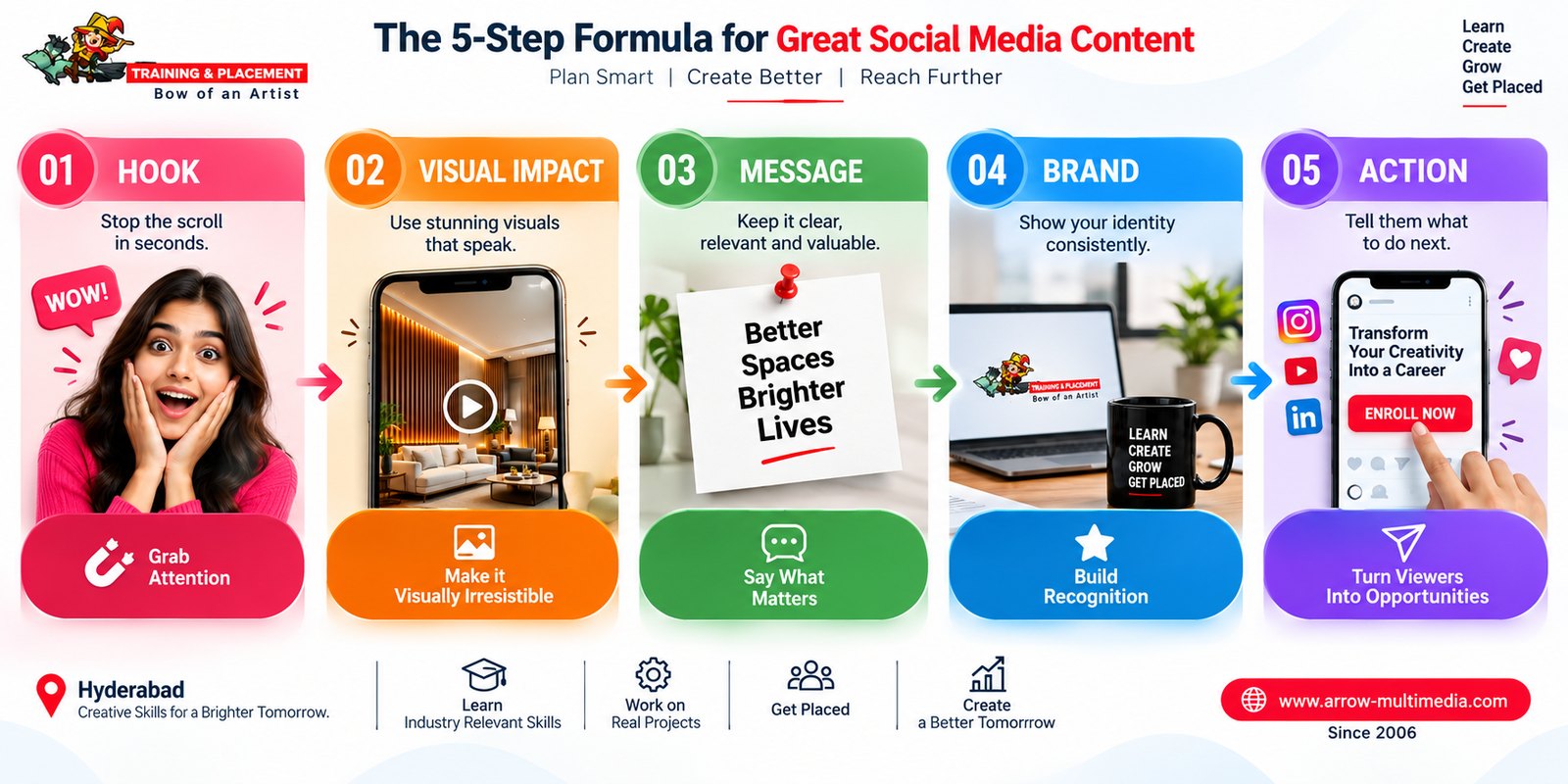
The next step is learning how to design for attention. Social media has a very different environment from a brochure or a printed advertisement — a viewer may see your design for only a few seconds, so the creative must communicate quickly.
- A clear focal point and readable hierarchy at thumbnail size
- Formats built for each platform, not one design resized
- Copy, colour and contrast that stop the scroll
- A consistent visual identity across a whole campaign
This is why social media design is becoming an important specialisation.
Video editing
The next transformation is from static design to moving content. Video editing teaches you timing, pacing, rhythm, music, sound, story structure, B-roll, transitions, colour, captions and platform formats.
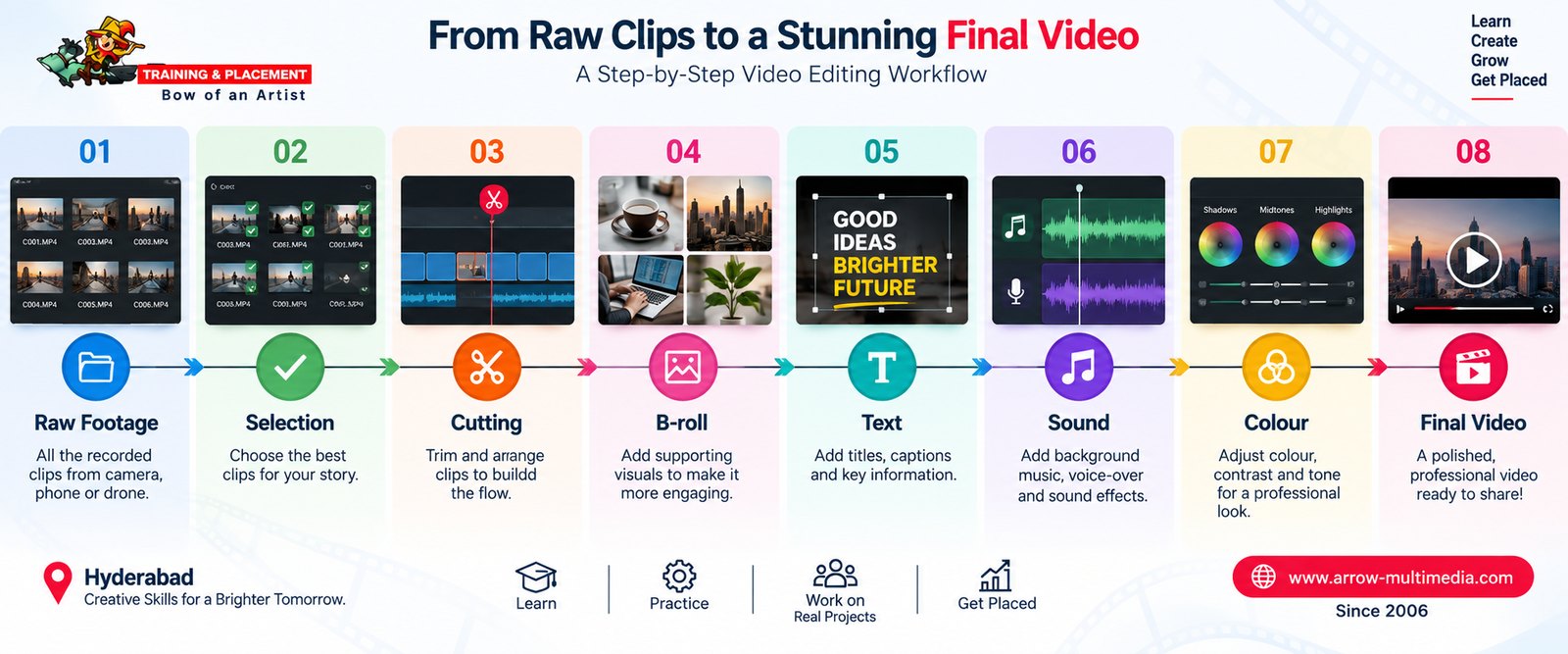
A good editor controls what the audience sees, when they see it and how they feel about it.
Motion graphics
Now imagine taking a static design and making it move. A title can appear. A logo can animate. A product can rotate. An infographic can explain a concept. A social media poster can become a Reel.
Tools such as After Effects allow designers to combine graphic design, animation, video and visual effects — a combination that opens opportunities in advertising, social media, television, e-learning, YouTube and production studios.
AI-assisted creative production
This is where the creative industry is undergoing a major transformation — with one important distinction.
AI is not replacing creative thinking. AI is becoming part of the creative workflow.
In 2026, Adobe has been adding AI capabilities directly into Photoshop, Illustrator, Premiere and other Creative Cloud workflows. Adobe's current Premiere capabilities include generating video and sound effects directly inside the editing timeline, while its broader Creative Agent initiatives are designed to automate multi-step production tasks while keeping the creative professional in control.
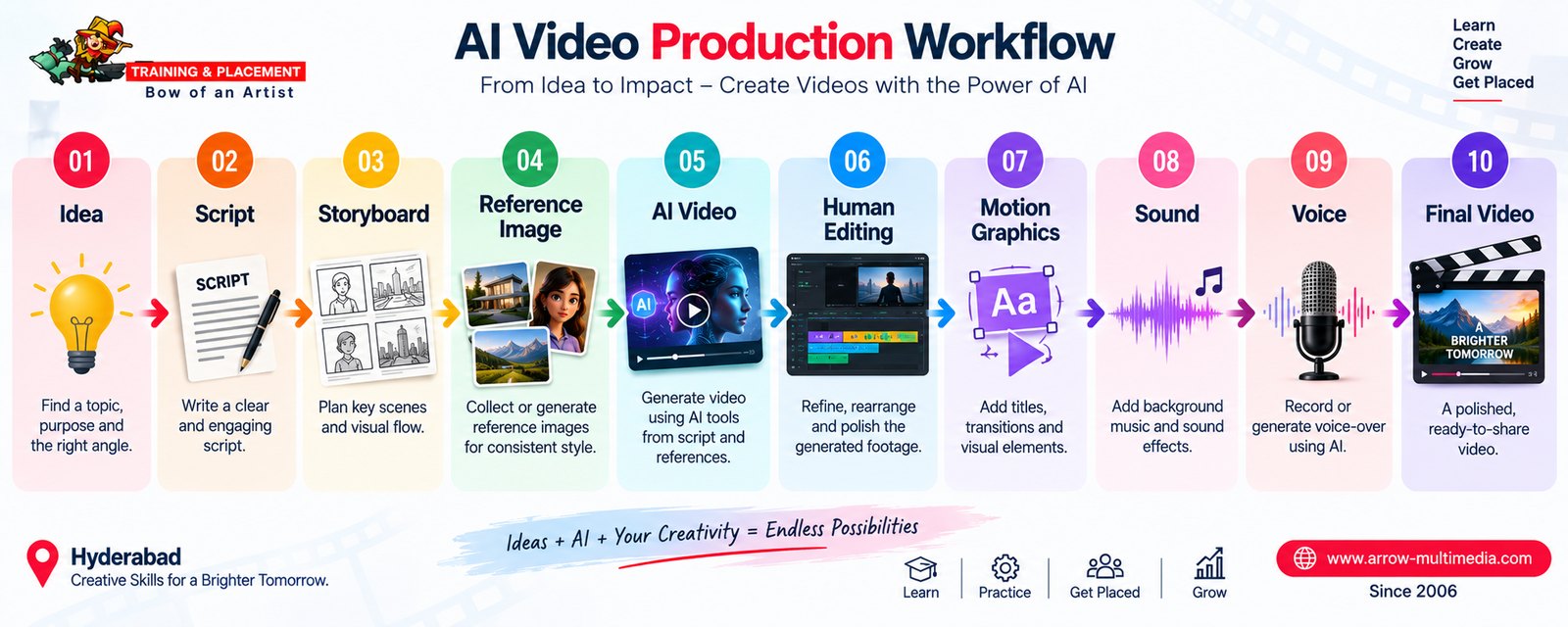
How the workflow is changing
Earlier workflow
- Idea
- Search for assets
- Download
- Edit
- Animate
- Export
AI-assisted workflow
- Idea
- Concept development
- AI visual exploration
- Design refinement
- AI-assisted video creation
- Voice generation
- Editing
- Motion graphics
- Human creative refinement
- Final content
The professional still makes the important decisions.
AI image creation
Imagine an advertising agency has an idea for a campaign but doesn't have the budget to photograph every possible visual concept. AI can help the team explore visual directions quickly — product environments, background concepts, characters, campaign concepts, moodboards and visual references.
But the AI-generated image is not automatically the final advertisement. The designer still has to judge whether the composition, lighting, brand fit, message and detail are actually right.
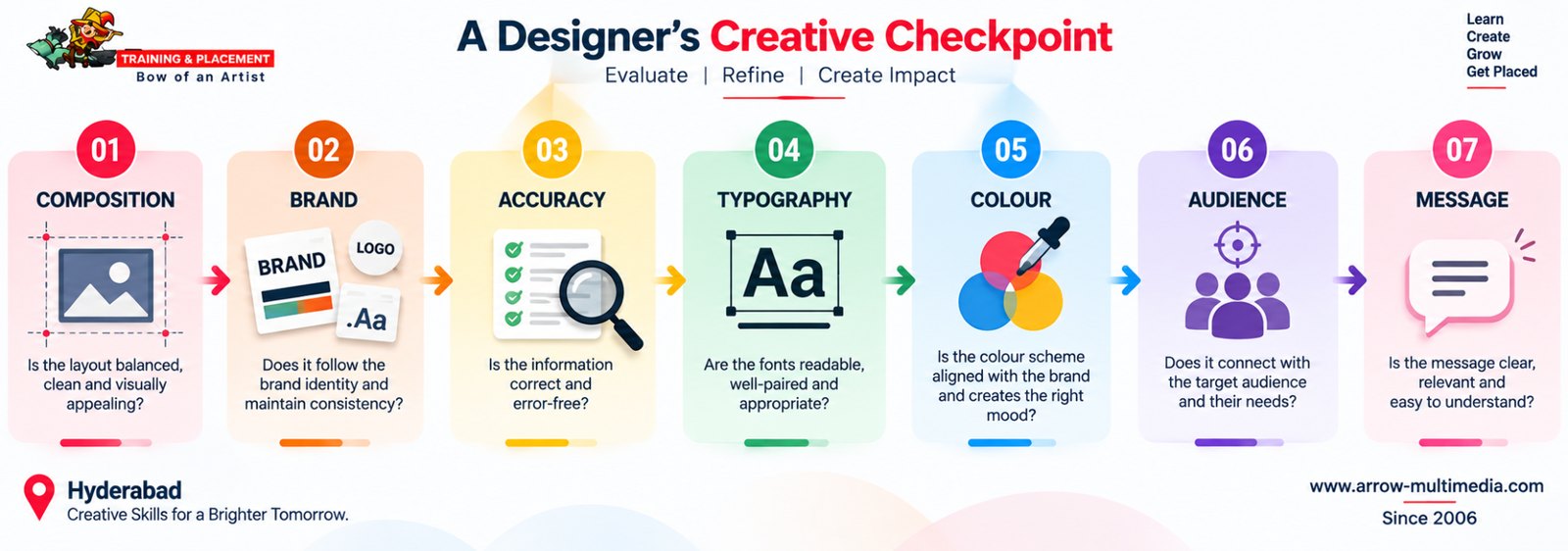
The creative professional becomes the director of the visual output.
AI video creation
AI video is moving rapidly from experimentation into practical production workflows. In September 2026, Adobe's Premiere updates included the ability to generate video and sound effects directly within the editing timeline, including reference-based generation and multiple supported AI models.
“I need a specific visual shot to complete this scene.”
Instead of leaving the editing environment, searching through libraries and rebuilding the workflow, an editor can create a starting point and then refine it.
AI voice & audio
Voice is another part of the production workflow that is changing. Tools such as ElevenLabs are being used for AI voice and audio workflows, including voice-over production and sound design, with tooling that integrates voice and sound effects into timelines.
For example, a creator producing a product explainer can develop:
- Script
- AI voice
- Product visuals
- Motion graphics
- Background music
- Sound effects
- Final video
But once again, the tool does not replace the creative decision. Someone still has to decide what the audience should hear, what they should see, where the emotion changes and where the visual pauses. That is storytelling.
The most valuable skill: storytelling
This may become the biggest difference between an average creative professional and an excellent one.
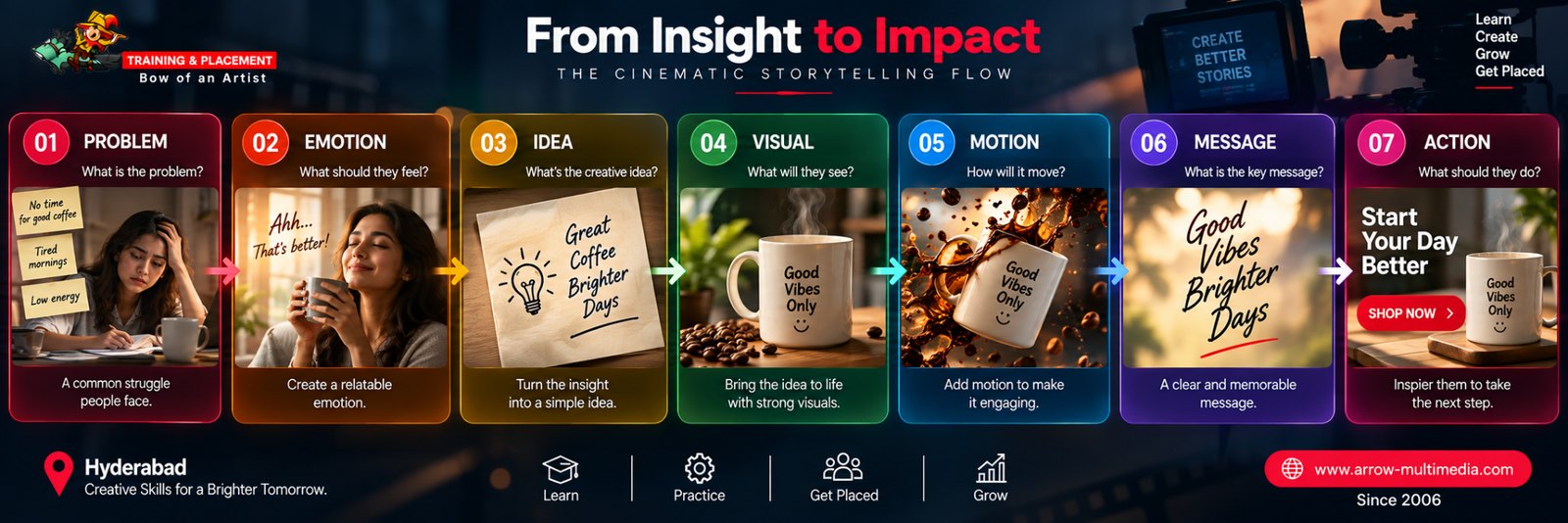
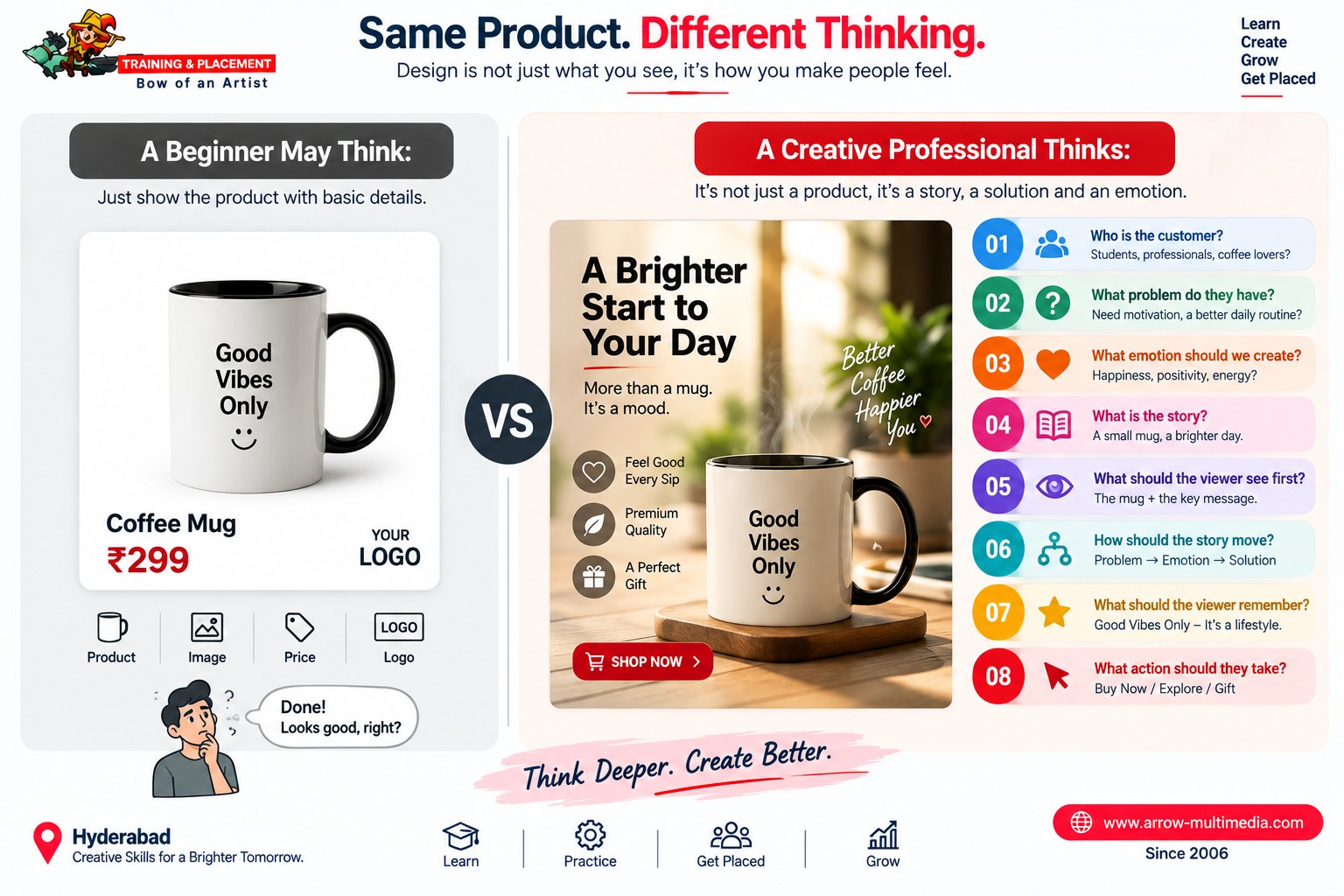
Two designers can have access to exactly the same software. One creates a beautiful poster. The other creates a campaign that people remember. Why? Because the second person understands the story behind the visual.
This is where graphic design, video editing, motion graphics and AI finally come together.
A realistic modern creative project
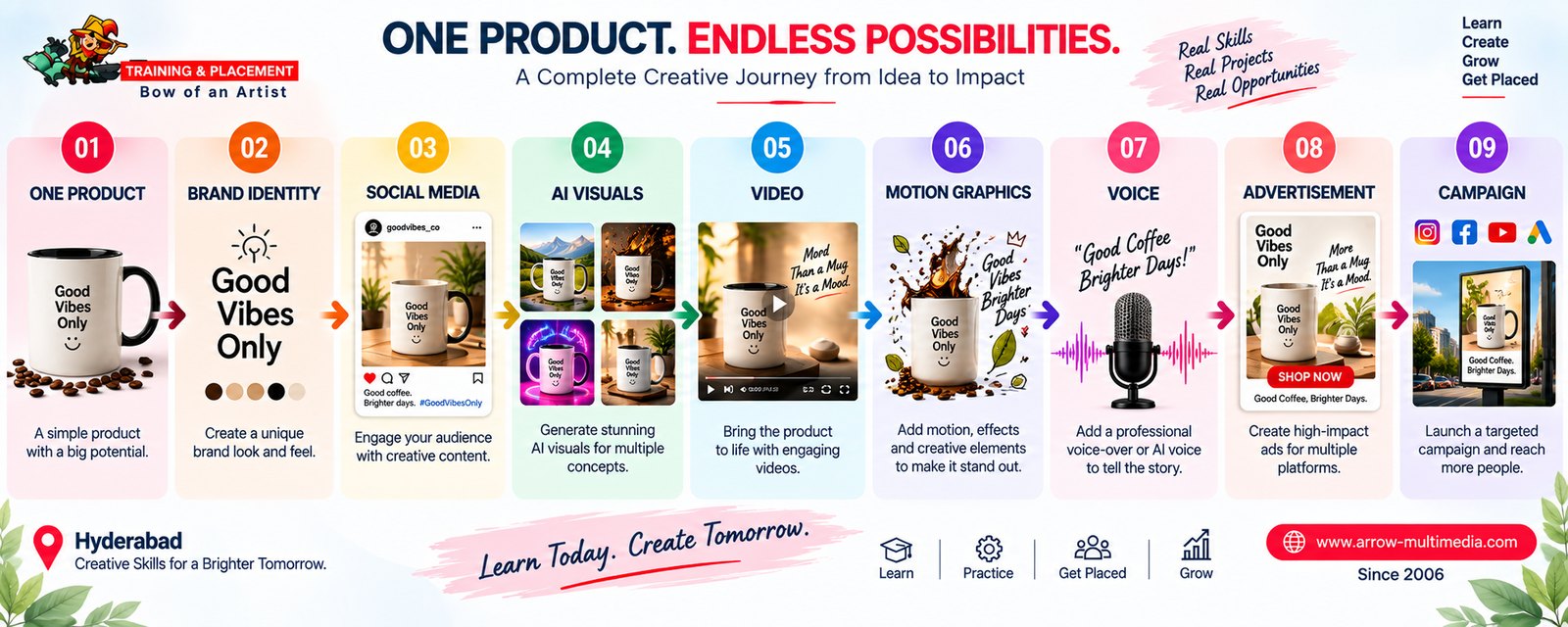
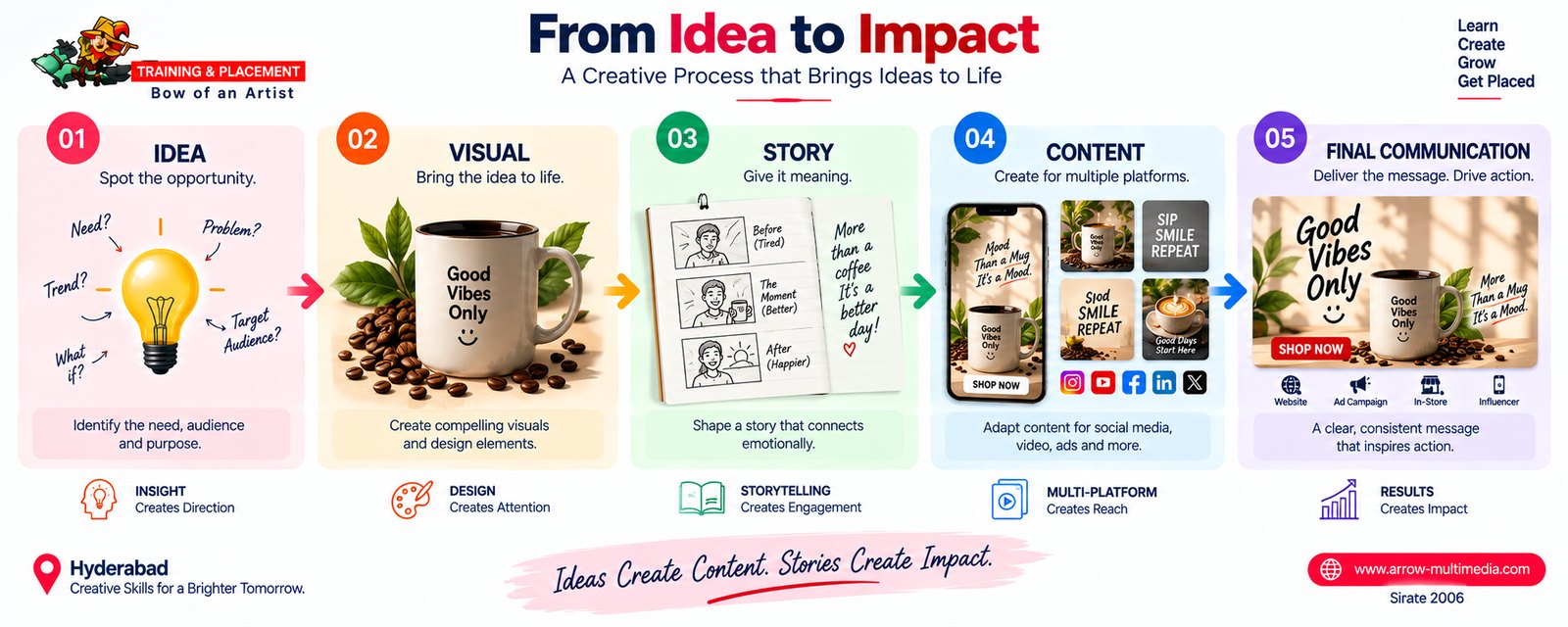
Imagine a company launching a new premium coffee brand. A modern creative team could build the campaign like this:
Logo, colour, typography, packaging.
“Your morning deserves better.”
Product photography plus AI-assisted concept visuals.
Posts, carousels, stories.
15-second Reel and a 30-second advertisement.
Animated logo, kinetic typography, product animation.
Professional or AI-assisted voice-over.
Instagram, YouTube, digital ads, website.
One idea has now become an entire creative campaign. This is the kind of project a student should eventually be able to show in a portfolio.
What job roles can these skills lead to?
The career does not end with the title “Graphic Designer.” Depending on your skills and specialisation, possible roles include:
Design
- Graphic Designer
- Visual Designer
- Digital Designer
- Brand Designer
- Social Media Designer
Video
- Video Editor
- Content Editor
- YouTube Video Editor
- Short-form Video Editor
Motion
- Motion Graphics Designer
- Motion Designer
- 2D Motion Designer
- Broadcast Graphics Designer
Content
- Content Creator
- Visual Content Creator
- Social Media Content Designer
- Creative Content Specialist
Advanced creative
- Senior Designer
- Art Director
- Creative Director
- Visual Storyteller
- Creative Producer
AI-assisted creative
- Titles are still evolving
- AI design, video and content work is appearing inside existing roles
Recent Indian job listings already combine graphic design, short-form video, motion graphics, visual storytelling and AI tools in a single position. That is an important signal for students:
Companies increasingly want people who can solve creative problems, not simply operate one software package.
What should a student learn?
A practical learning roadmap could look like this:
- Design foundationComposition, typography, colour, layout, Photoshop, Illustrator.
- Digital contentSocial media design, branding, campaign design, thumbnails, content formats.
- VideoEditing, story structure, sound, colour, short-form content.
- MotionAnimation principles, keyframes, typography animation, logo animation, motion graphics.
- AIIdeation, image generation, image editing, video generation, voice, audio, production assistance.
- StorytellingConcept development, script, storyboard, audience, emotion, visual communication.
- Professional practiceReal-world projects, campaigns, videos, motion graphics, AI-assisted work, portfolio and showreel.
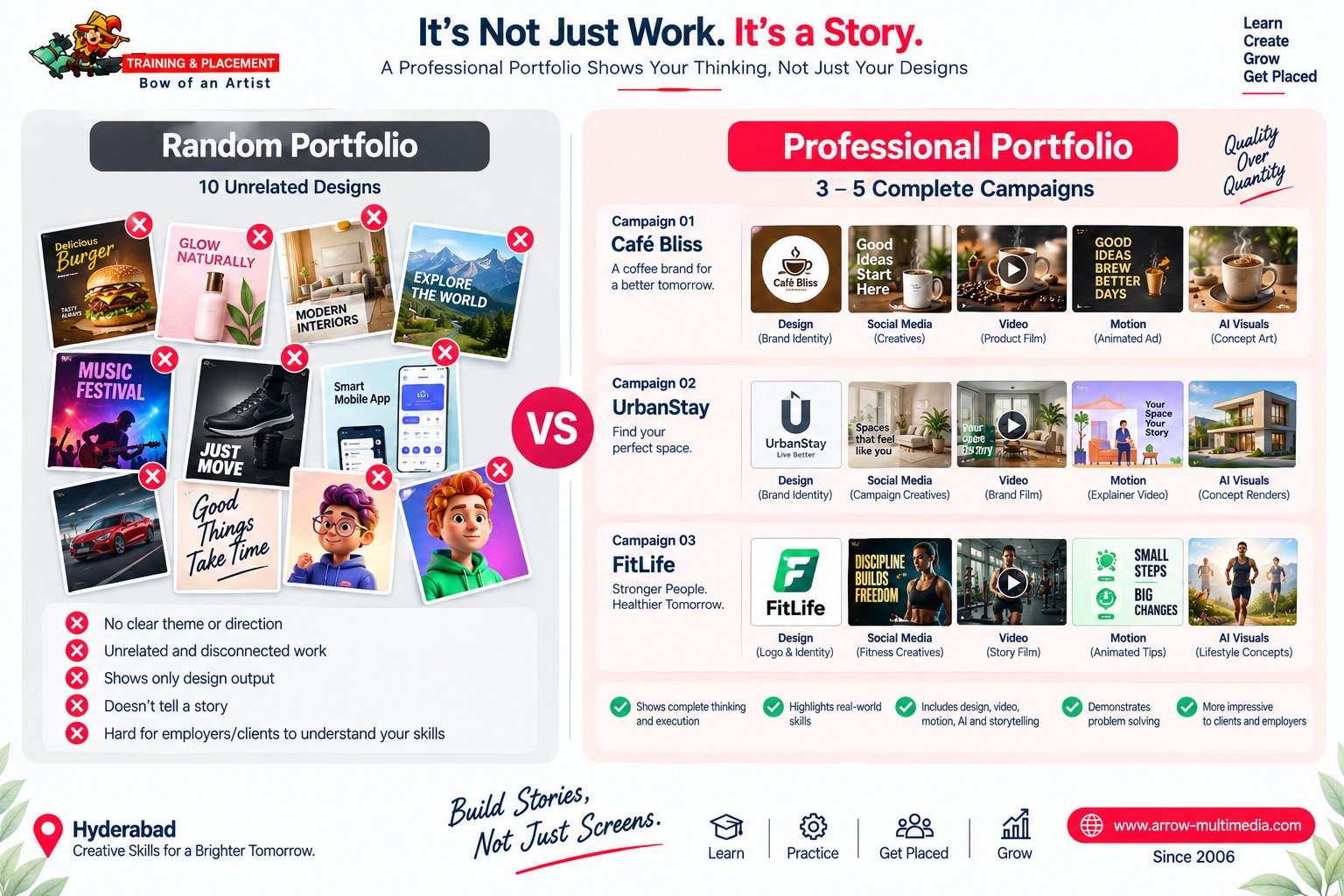
Don't build a portfolio full of random designs
This is one of the biggest mistakes students make. A portfolio containing “Poster 01, Poster 02, Logo 01, Poster 03, a Photoshop manipulation and a random Reel” does not demonstrate professional ability.
Instead, build complete projects. For example:
Project: product launch campaign
- Challenge — launch a new product.
- Concept — define the creative idea.
- Visual direction — moodboard, colour, typography.
- Design — the social media campaign.
- Video — a promotional Reel.
- Motion — animated typography and product graphics.
- AI — AI-assisted visual exploration.
- Final campaign — the finished communication.
Now the employer can see thinking, design, editing, motion, AI and storytelling — rather than a collection of files.
What makes a creative professional future-ready?
It is not knowing the maximum number of software packages. It is the ability to move from an idea to a finished piece of communication.
AI can make production faster. Software can make production possible. But creative judgment determines whether the final result is good — which is why strong fundamentals remain important even as AI becomes more powerful.
The future creative professional
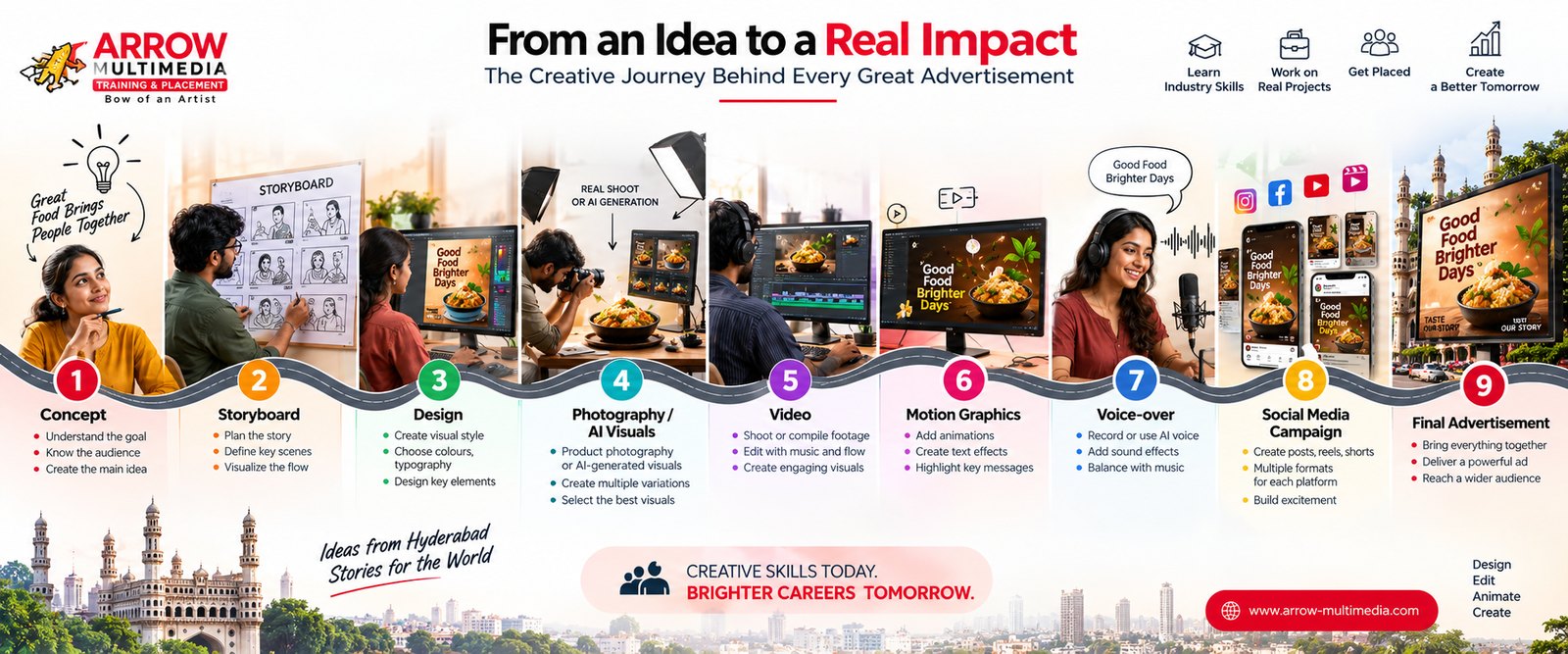
The professional of the future may begin with a simple sentence — “I have an idea” — and then turn it into:
- Concept
- Storyboard
- AI visuals
- Graphic design
- Video
- Motion graphics
- Voice & sound
- Social content
- Advertisement
- Campaign
That is a very different career from simply creating a poster.
So, is this career right for you?
A career in graphic design, video editing and motion graphics may be a good fit if you enjoy:
You do not have to become an expert in everything. You can eventually specialise in graphic design, video editing, motion graphics, social media content or AI-assisted creative production. But understanding the entire workflow gives you a much stronger foundation.
From learning software to building a creative career
The most important mindset shift is simple. Don't learn Photoshop just because Photoshop is popular. Don't learn Premiere just because companies use Premiere. Don't learn After Effects just because motion graphics is trending. And don't learn AI simply because everyone is talking about AI.
Learn them because they help you solve a creative problem.
- Design helps you communicate.
- Video helps you tell stories through time.
- Motion helps you create movement and attention.
- AI helps you explore and produce faster.
- Storytelling gives everything a purpose.
- Portfolio proves that you can do the work.
Together, they create a powerful modern creative skillset.
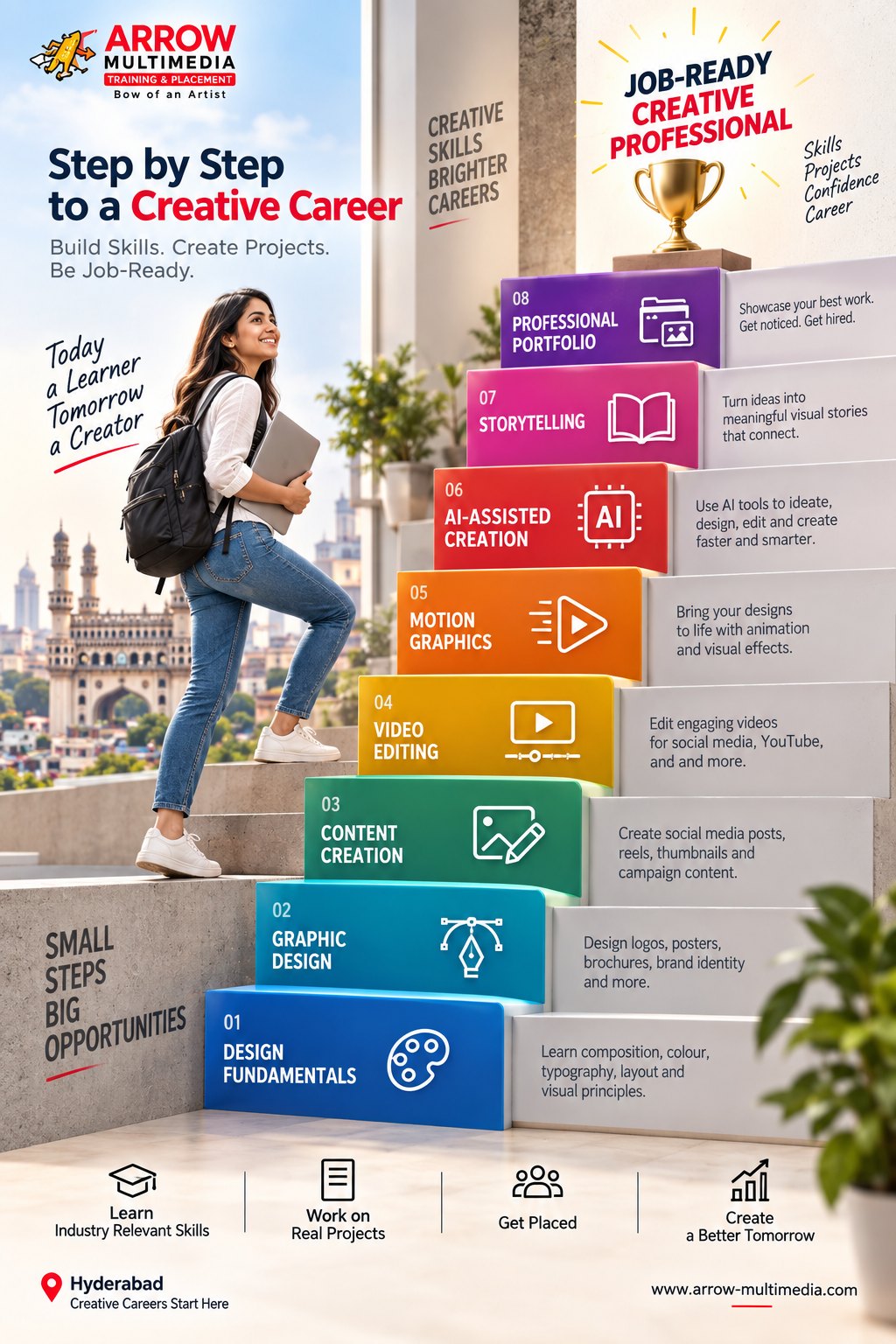
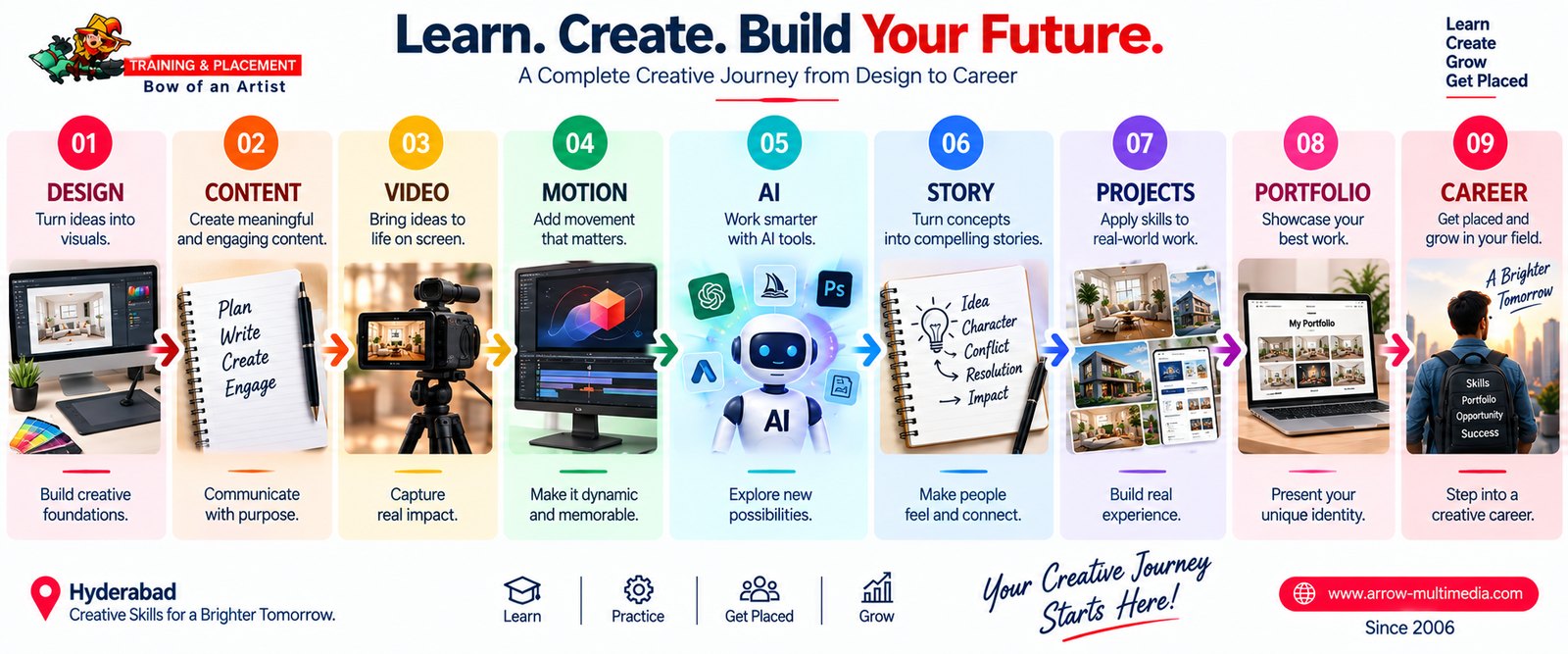
A simple career roadmap
- Start — design fundamentalsLearn how visual communication actually works.
- Create — graphic designTurn fundamentals into finished design work.
- Communicate — social media contentDesign for attention and for each platform.
- Edit — video editingLearn timing, pacing, sound and story structure.
- Animate — motion graphicsMake design move with animation principles.
- Accelerate — AI-assisted creationUse AI for ideation, visuals, video and voice.
- Think — storytellingConcept, script, storyboard, audience, emotion.
- Build — real-world projectsComplete campaigns instead of random files.
- Show — portfolio & showreelProve the thinking behind the work.
- Launch — creative careerEnter the industry with a job-ready body of work.
Final thought
The creative industry is not disappearing because of AI. It is changing. Professionals who understand only one tool may find themselves competing on speed. Professionals who understand design, content, video, motion, AI and storytelling can compete on something far more valuable: creative thinking.
The question is no longer “Can you use Photoshop?” It is becoming:
“Can you take an idea and turn it into compelling visual content?”
If the answer is yes, there are many directions your creative career can take — from social media and YouTube to advertising, e-learning, television, corporate communication, production studios and AI-powered content creation. And that is what makes graphic design + video editing + motion graphics such a powerful combination for today's creative industry.
Explore a career in creative design & media
If you are looking for structured training that combines graphic designing, video editing, motion graphics, practical projects and modern AI-assisted creative workflows, a career-focused program can help you move from learning software to creating professional work.
The goal is not to complete a course. The goal is to become someone who can create.
Design. Edit. Animate. Create with AI. Tell stories. Build a portfolio. Start your career.
Talk to a course advisor View coursesWhy choose Arrow Multimedia for your creative career?
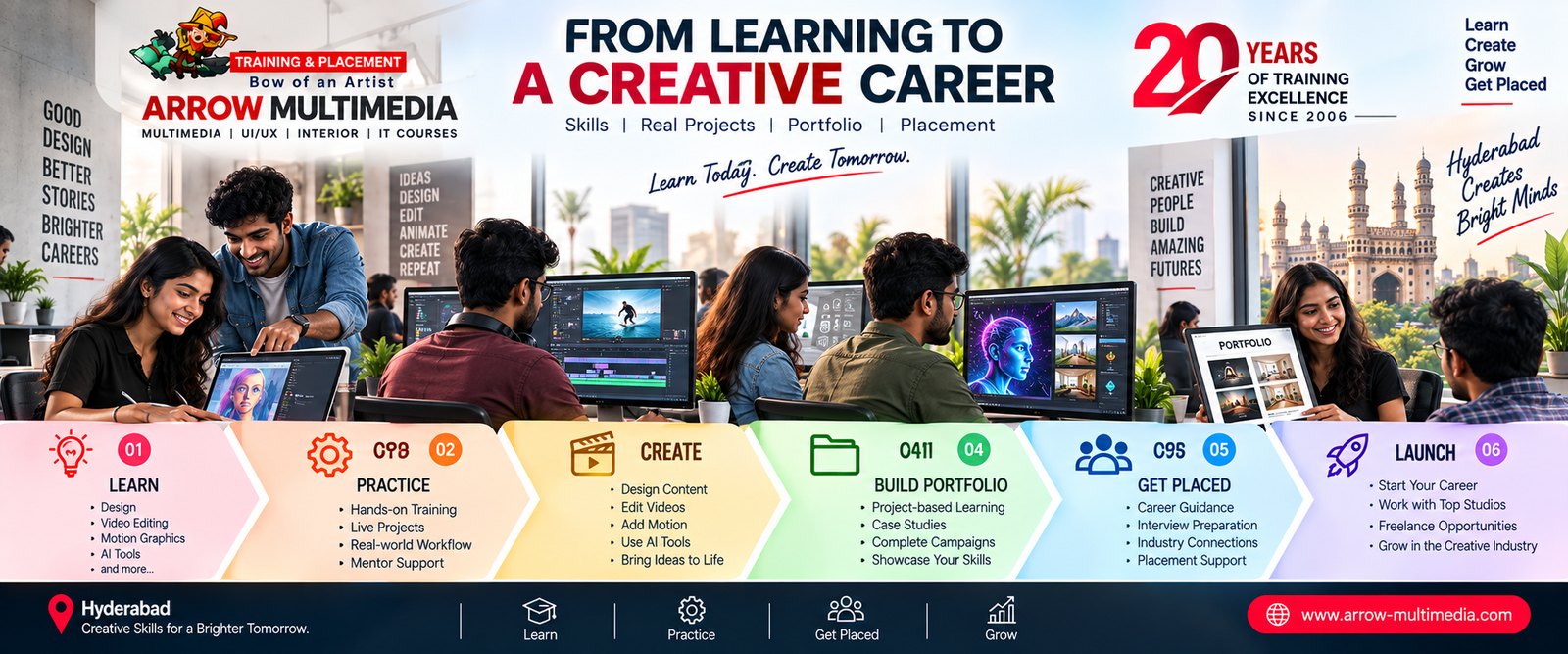
Choosing the right training institute can make a significant difference when starting a career in graphic designing, video editing and motion graphics. Learning software is only the beginning. What matters is how well you can apply those skills to real projects, build a professional portfolio and prepare yourself for the creative industry.
Established in 2006, Arrow Multimedia has completed 20 years of experience in multimedia, animation and digital media training. Over two decades, the creative industry has changed from print and traditional multimedia to digital content, social media, video production, motion graphics and AI-assisted creative workflows. Arrow Multimedia has continuously evolved its training approach along with these changes, helping students develop industry-relevant creative skills rather than learning software in isolation.
The Arrow advantage
-
Learn industry-relevant skills
Build a strong foundation in graphic design, visual communication, content creation, video editing, motion graphics and modern AI-assisted creative workflows.
-
Learn through practical projects
Move beyond classroom exercises and work on creative assignments that simulate the design, video and content work produced in today's industry.
-
Build a job-ready portfolio
Get guidance on developing a portfolio that demonstrates creative thinking, storytelling, design ability, video editing, motion graphics and problem-solving — not just software skills.
-
Learn with experienced professionals
Learn from trainers and creative professionals with practical industry understanding and experience of how the multimedia and digital content industry has evolved.
-
Placement & career support
Arrow Multimedia has a long-standing presence in Hyderabad's creative training ecosystem, with students pursuing opportunities across social media content, YouTube production, e-learning, advertising, television and media and digital agencies.
-
Prepare for the AI-powered creative industry
Understand how AI for image generation, video creation, voice, ideation and production assistance fits into a professional workflow — while keeping human creativity and storytelling at the centre.
Frequently asked questions
Is graphic design still a good career in 2026?
Yes, but the role has widened. The strongest opportunities now go to people who can combine design with social media content, video editing, motion graphics and AI-assisted production rather than depending on a single skill.
Do I need to learn video editing if I want to be a graphic designer?
It is not compulsory, but it makes you far more useful. Most campaigns today need both static and moving content, and many Indian job listings now ask for design plus short-form video in the same role.
Will AI replace graphic designers and video editors?
AI is becoming part of the workflow rather than a replacement for creative thinking. It can generate starting points quickly, but a person still decides the concept, the story, the brand fit and the final quality.
Which software should I start with?
Begin with design fundamentals in Photoshop and Illustrator, then move to Premiere Pro for editing and After Effects for motion graphics. Add AI tools once you understand why a design or an edit works.
What should my portfolio contain?
Complete projects rather than scattered files. Show the challenge, the concept, the visual direction, the design work, the video, the motion graphics and the final campaign so an employer can see your thinking.