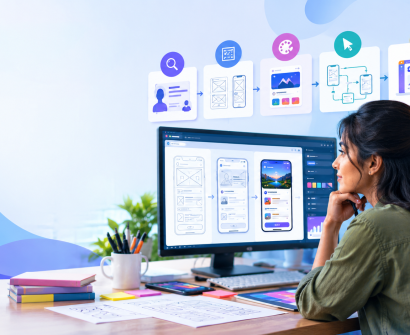


AI is redefining how designers research, conceptualize, prototype, and deliver stunning digital experiences. Instead of replacing designers, AI is accelerating their creative power and reducing repetitive tasks. Here are the most impactful AI tools revolutionizing UX/UI work in 2025.
1. Figma AI
Figma has evolved into a design assistant that can generate layouts, auto-align elements, suggest color schemes, and convert wireframes into hi-fi UI — dramatically reducing concept-to-mockup time.
2. Uizard
Uizard turns hand-drawn sketches, screenshots, and text prompts into fully-editable UI designs. It enables non-designers and product managers to ideate visually with ease.
3. Midjourney (for UI Inspiration)
Designers are using AI image-generation prompts to explore unique UI styles, icons, design language, illustration styles, and visual concepts that spark creativity.
4. Galileo AI
Galileo accepts text prompts (e.g., “Create an onboarding flow for a fitness app”) and generates professional interfaces instantly — including component layouts and UI structure.
5. Framer AI
Framer allows designers to create full responsive websites and prototypes using natural language commands. It eliminates manual coding and enables fast MVP testing.
6. Khroma (AI Color Generator)
Khroma learns a designer’s visual taste and recommends refined color palettes that maintain harmony and accessibility standards.
7. Attention Insight (AI Heatmaps)
This tool predicts user focus using AI-based eye-tracking to determine where users are likely to look — before user testing even begins.
8. UserTesting AI & UX Feedback Bots
AI can now synthesize usability responses, detect frustration patterns, extract UX insights, and save hours of analysis work.
9. Copy.ai & Notion AI for UX Microcopy
These tools help generate onboarding messages, button labels, error states, instructions, and tone-consistent UX text.
10. Maze + AI User Analytics
Maze now uses AI to automatically analyze user behavior patterns, drop-offs, and interaction metrics to inform UX improvements.
How AI is Changing the Designer’s Role
Instead of pixel pushing, designers now focus on:
user psychology
UX strategy
human-centered thinking
journey mapping
accessibility
emotional design
experience storytelling
AI handles repetitive tasks — humans handle creativity and empathy.
Final Thoughts
AI is not replacing UX/UI designers — it is empowering them. Designers who embrace AI tools gain massive advantages in speed, iteration, and innovation. The future of UX/UI is human-led and AI-assisted — not AI-controlled.